
SEO and GEO in 2026: What US Agency Founders Actually Need
Visual2Action is a professional SEO fulfillment partner for US agency founders.
Your clients are asking why their competitor shows up in ChatGPT answers. Your team does not have a clean answer yet. That is not a content problem. It is a strategy gap. This article covers what SEO and GEO each do, where they conflict, and what running both correctly looks like in 2026.
What GEO Is, and Why the Definition Keeps Getting Mangled
Generative Engine Optimization is the practice of structuring content so that large language models cite it when generating answers.
That is the whole definition. It is not a rebranded version of SEO. It is not “AI SEO.” It operates on a different retrieval mechanism entirely.
Traditional SEO signals relevance and authority to a crawl-based indexing system. Google reads the page, scores it, and ranks it. The user clicks a result.
GEO works differently. A language model does not rank pages. It synthesizes content from sources it was trained on, or that a retrieval layer feeds it at query time. If a client’s content is not structured for citation, the model ignores it regardless of domain authority.
The confusion happens because both disciplines involve content and both involve search. That surface similarity is where the misreading starts. The mechanics are separate. Running one does not cover the other.
The practical consequence for agency founders: your clients will start holding you accountable for LLM visibility, not just Google rankings. That accountability is arriving whether or not your current deliverables address it. The agencies already ahead of this did not wait for client questions to prompt the conversation.
What SEO Still Does That GEO Cannot Replace
SEO is not dying. That framing is lazy, and it costs agencies clients when they repeat it.
Google’s organic results still drive the majority of commercial intent clicks. A local business still depends on map pack rankings. An e-commerce client still converts through category pages that rank. The infrastructure behind those outcomes, including technical crawlability, Core Web Vitals, on-page optimization, and E-E-A-T signals, is active and measurable.
Google Search Central publishes guidance that continues to reward well-structured, authoritative content. That guidance has not shifted to tell publishers to stop optimizing for traditional search.
What has changed is that Google’s own search engine results pages now contain AI Overviews. A user who sees a synthesized answer at the top of the page may not click at all. That changes traffic volume for informational queries. It does not eliminate organic search as a channel. It changes the conversion math.
SEO in 2026 means optimizing for both the ranked result and the AI Overview that may sit above it. Those are two different content targets on the same page.
Founders who positioned their agencies as “pure SEO shops” in 2023 are now the ones re-explaining value to clients. That re-explanation gets harder every quarter that AI Overviews expand. The agencies with current fulfillment infrastructure are having a different conversation.
How GEO Works Technically
Large language models are trained on text. They learn associations, patterns, and factual structures from what they have ingested. When a model generates an answer, it draws from that training, and in most production systems, from a retrieval-augmented generation layer that feeds it live documents at query time.
Research published by Anthropic and OpenAI both confirm that factual grounding improves when source documents are well-structured, clearly attributed, and consistent in terminology.
For GEO execution, that translates to four specific decisions.
Claim specificity. Models cite content with precise, verifiable claims more reliably than vague generalizations. “A site migration without a redirect map costs an average of 30 to 60 percent of organic traffic in the first 90 days” is citable. “Site migrations can cause traffic problems” is not.
Entity consistency. If a brand name, service category, or location is described three different ways across a client’s web presence, the model builds a weaker association. One name. One description. Every page.
Structured markup. FAQ schema, HowTo schema, and entity markup that describes relationships between concepts improve the likelihood that a retrieval system surfaces the page at query time.
Citation-ready prose. Content written in complete sentences with clear subject-predicate structure gets lifted and attributed more reliably than bullet-heavy, fragmented writing. This is one place where SEO best practices and GEO best practices genuinely conflict, and it requires a deliberate call from the writer.
Semrush’s GEO research found that content with statistics and direct citations was referenced more frequently by generative engines. That is a starting point, not a complete framework. But it confirms that structural choices have measurable citation consequences.
GEO is not magic. It is applied understanding of how language models retrieve and attribute information. The agencies winning here treat it as a craft discipline, not a checklist item.
Where SEO and GEO Conflict
Running both simultaneously without a governing framework creates friction. Three places it surfaces most often.
Keyword density versus natural language. Traditional SEO has rewarded targeted keyword repetition. Language models treat unnatural repetition as a low-quality signal. A page optimized aggressively for a single keyword phrase may perform in Google’s index but get skipped by an LLM because the writing reads as stuffed. Optimize for the reader first. Check SEO and GEO signals against the result, not the other way around.
Long-form versus answer-ready structure. Long-form content typically outperforms short content in traditional SEO for competitive keywords. It can work against GEO if it buries the direct answer. A model generating a concise response skips a 3,000-word page that does not surface its answer until section six. Answer first, depth second. That is not a new content principle. It requires deliberate execution in every draft.
Link acquisition versus citation acquisition. In SEO, a backlink from an authoritative domain improves ranking signals. In GEO, the equivalent signal is appearing in content that language models have ingested heavily. Those two pools overlap but are not identical. Moz’s authority research validates the link-based authority model for traditional search. That framework does not translate directly to GEO citation rates.
A fulfillment partner that learned SEO in 2021 and added “AI” to their service list in 2024 has not resolved these conflicts. They have renamed them.
What a Dual-Discipline Fulfillment Stack Looks Like
A client account managed for both SEO and GEO in 2026 has specific operational requirements at every layer.
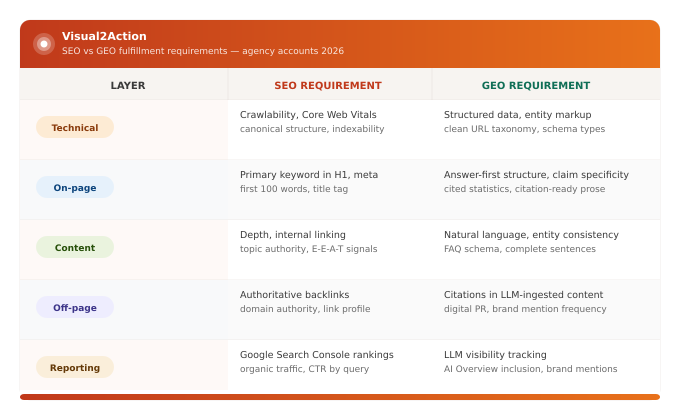
Every row requires active management. A team strong in technical SEO that has not built GEO execution into its standard operating procedure will leave the right column empty on every account.
The reporting gap is more visible than the execution gap. A client who sees their competitor cited in a ChatGPT answer does not want to hear about domain authority. They want to know what is being done about it. If the answer requires building infrastructure first, that answer arrives too late.
Visual2Action builds both columns into every campaign scope. Not as an add-on tier. As the default definition of what Professional SEO Services means in 2026. To see exactly how that is structured for white label delivery, the contact page is the fastest way to get a direct answer.
The Reporting Gap That Will Cost You Client Renewals
Founders are losing clients right now not because their SEO work is failing but because they cannot report on what the client is asking about.
A client opens ChatGPT, types a query about their own service category, and sees a competitor’s name. They ask their agency what is being done about LLM visibility. If the agency does not have a coherent answer and a current reporting setup, the client reads that as incompetence. It does not matter if Google rankings are healthy. The client is looking at a different screen.
The reporting infrastructure for GEO is less mature than SEO reporting. Google Search Console does not have a direct equivalent for LLM citation tracking. The gap is closing. Platforms including Semrush and Ahrefs are adding AI visibility features into their existing platforms.
A white label fulfillment partner running GEO properly already has this reporting infrastructure in place. They do not build it after you ask for it. That is the operational difference between a team that has been running both disciplines for twelve months and a team that read about GEO last quarter.
The Honest Take: What Happens If You Only Run One
SEO only. Your clients hold their Google rankings. But AI Overviews sit above organic results for informational queries. Click-through rates on those query types continue to decline. Your traffic reports show ranking stability while informational traffic drops. Clients who do their own research find competitors showing up in LLM answers. The renewal conversation becomes harder every quarter you cannot explain why.
GEO only. Your clients get cited in ChatGPT and Perplexity answers. But there is no infrastructure to capture commercial intent traffic that still converts through Google’s organic results. Local search visibility erodes without the technical and on-page work that supports map pack rankings. LLM citations do not convert at the same rate as high-intent organic clicks. You are building presence in one channel while neglecting the channel that still closes deals.
Running only one is not a strategic position. It is a coverage gap that either the client or the market will eventually name for you.
Frequently Asked Questions
Does GEO replace SEO for agency clients in 2026?
No. SEO and GEO address different search surfaces. Google’s organic results continue to generate commercial intent traffic that GEO-only strategies do not capture. Both need to run simultaneously with a unified content strategy that does not sacrifice one for the other.
How do I explain GEO to a client who has never heard the term?
Ask the client to search for a query about their own service category in ChatGPT or Google’s AI Overview. If a competitor appears and they do not, that is the gap. The explanation does not require technical depth. The visibility difference is visible in thirty seconds.
Are there tools to track LLM citation visibility for client reporting?
Yes, and the category is developing fast. Semrush and Ahrefs are building AI visibility features into their existing platforms. A fulfillment partner running GEO correctly already tracks this. They do not add reporting infrastructure after a client asks for it.
Does structured data directly improve LLM citation rates?
The direct relationship is an active research area. The working evidence supports structured content performing better in generative answer systems. FAQ schema and entity markup also improve Google AI Overview inclusion. Structure serves both channels, which makes it one of the few non-conflicting decisions across SEO and GEO.
What should I ask a fulfillment partner to prove they can run GEO?
Ask them to describe three specific content changes they make for GEO that they would not make for an SEO-optimized piece. Ask what they use to track LLM visibility and how they report it. Ask when they built that reporting into their standard delivery, not when they plan to. A partner who gives vague answers has not built GEO into their execution. They have added the word to their service list.
Can one piece of content be optimized for both SEO and GEO at once?
Yes. Answer-first structure, entity consistency, FAQ schema, and citation-ready prose serve both surfaces. Write for the reader first. Check both SEO and GEO signals against the result afterward.
Is GEO relevant for local search clients, or only for informational content?
GEO is increasingly relevant for local search. Voice assistants and AI-powered map features surface synthesized answers for local queries. A home services client or law firm that appears consistently in AI-generated local recommendations is building a visibility layer that traditional local SEO does not cover.
If your fulfillment operation does not have both SEO and GEO built into its standard delivery scope, your clients are running with a gap they do not know about yet. They will find out through a competitor’s visibility, not through a report you send them.
Visual2Action builds SEO and GEO execution into every campaign as the default scope. Akash Dave, founder of Visual2Action, stays on every account personally. No junior hand-off after month three. No reassignment after onboarding. The 1-Month Risk-Free Trial runs on a real account with actual deliverables. Walk away after month one with no invoice and no conversation required.
If you are ready to run both disciplines without managing two vendors, start with Visual2Action’s SEO Services or go directly to the contact page to talk scope. You can read more about how the operation is built on the About page.