
The Ultimate Guide to Mastering PPC Advertising
Pay-per-click advertising has not gotten simpler. It has gotten faster, more automated, and less forgiving of lazy structure. If you are running Google Ads the way you did in 2022, you are almost certainly overpaying per click and underperforming on conversion. This guide covers how PPC advertising actually works today, how the auction system decides who wins and who overpays, and what it takes to build campaigns that produce results rather than just traffic.
At Visual2Action, we manage paid media campaigns as part of a broader performance fulfillment model for agency founders. What we write here comes from active accounts, not textbooks.
What PPC Advertising Actually Is (and Why the Definition Matters)
PPC advertising is a digital buying model where you pay only when someone clicks your ad. You do not pay for impressions. You do not pay for views. You pay for the click itself.
That sounds simple. The complexity lives in what happens before and after that click.
Before the click, your ad competes in a live auction against every other advertiser targeting the same keyword at the same moment. The auction runs in milliseconds. Your bid amount is one input. Your Quality Score, your ad relevance, your landing page experience, and the context of the user’s search are the others. A lower bid with a higher Quality Score can and does beat a higher bid with weak relevance. Google rewards ads that match what the searcher actually wants.
After the click, you are paying for a visitor who has shown intent. What happens next depends entirely on your landing page. A well-matched landing page converts that intent into a lead or a sale. A poorly matched one wastes the spend.
The major PPC platforms as of 2026 are:
- Google Ads — Search, Display, Shopping, Performance Max, YouTube, Demand Gen
- Microsoft Ads — Search and Audience Network (Bing, Yahoo, AOL, LinkedIn targeting)
- Meta Ads — Facebook and Instagram, interest and behavior-based
- LinkedIn Ads — B2B targeting by job title, company size, industry
- TikTok Ads — Short-form video, strong for consumer and direct-to-purchase brands
For most businesses with commercial intent, Google Ads Search campaigns are the starting point. The intent signal from a search query is the strongest buying signal in digital advertising.
How the Google Ads Auction Works in 2026
Every search on Google triggers a separate auction. This is not a one-time setup. It runs fresh, every time, for every query.
What determines who wins:
Google calculates something called Ad Rank. Ad Rank is not just your bid. It is a combination of:
- Your maximum bid (what you are willing to pay per click)
- Your Quality Score (a 1 to 10 diagnostic rating based on expected CTR, ad relevance, and landing page experience)
- The expected impact of your ad assets (extensions like sitelinks, callouts, phone numbers)
- The context of the search (device, location, time of day, query phrasing)
- The competitiveness of that specific auction
The advertiser with the highest Ad Rank wins the top position. Importantly, a higher Ad Rank also means a lower actual cost per click. You do not pay your maximum bid. You pay just enough to beat the advertiser ranked below you.
This is why Quality Score matters. A Quality Score of 8 out of 10 means you can often occupy the same position as a competitor bidding 30 to 50 percent more. The system is designed to reward relevance, not budget size.
What Quality Score measures:
|
Component |
What Google Evaluates |
|
Expected CTR |
Will users click this ad when shown for this keyword? |
|
Ad Relevance |
Does the ad copy match the intent behind the search? |
|
Landing Page Experience |
Is the destination page relevant, fast, and useful? |
A common mistake is chasing a 10/10 Quality Score across every keyword. Google itself states that Quality Score is a diagnostic tool, not a campaign KPI. Focus on fixing ad groups where the score is below 5 and the volume is meaningful. That is where budget is being wasted.
See diagram file:
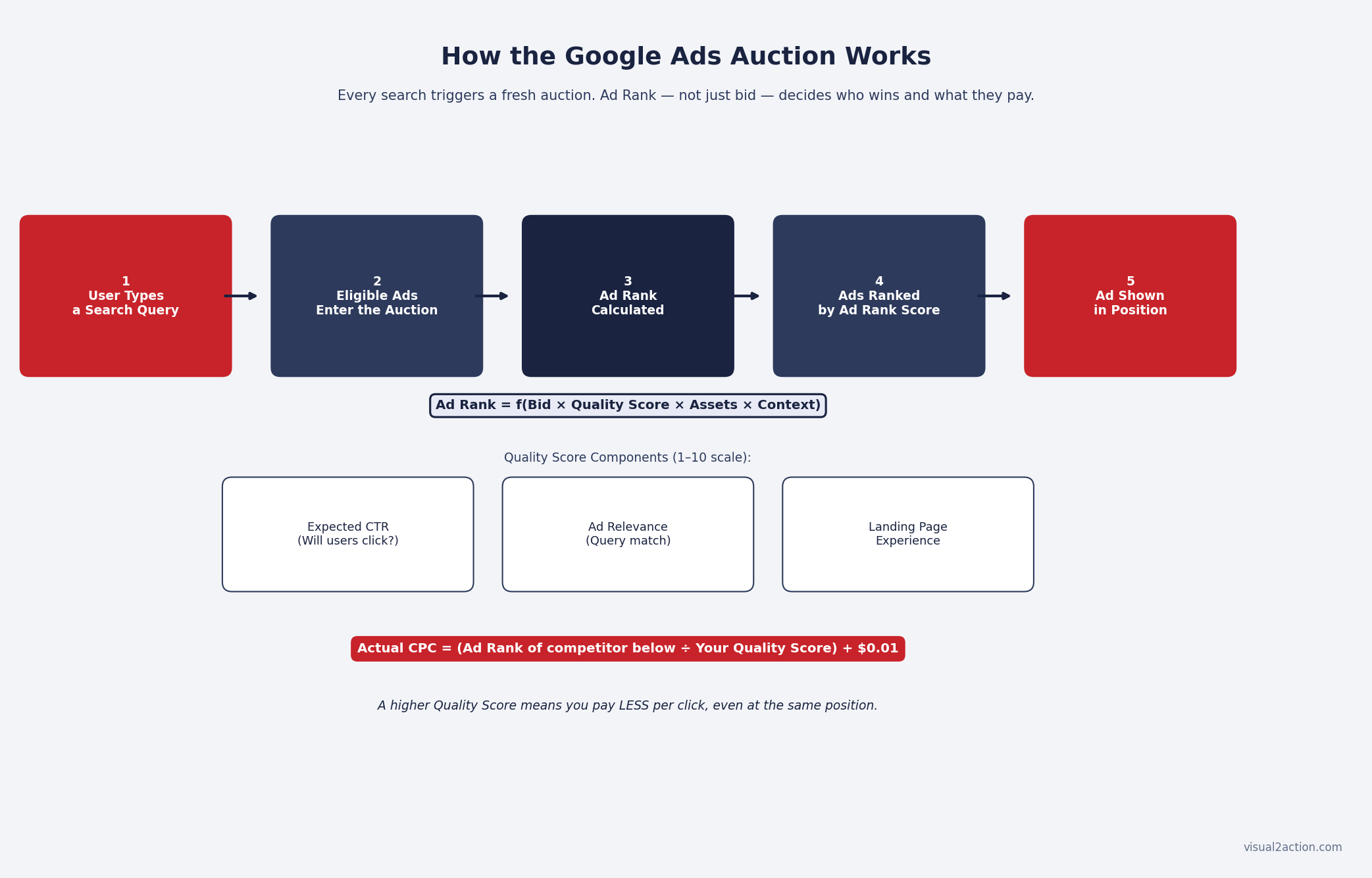
[DIAGRAM 1: The Google Ads Auction Flow]
Keyword Research and Match Types: What Still Works in 2026
Keyword research is still the foundation of paid search. However, match types now behave differently than they did even two years ago.
The three active match types:
|
Match Type |
Behavior |
Best Used For |
|
Broad Match |
Google expands to semantically related queries |
Works best when paired with Smart Bidding and audience data |
|
Phrase Match |
Matches queries that include your phrase in meaning |
Balanced control with decent reach |
|
Exact Match |
Only shows for queries that match intent closely |
High-intent, high-value terms where you want full control |
What changed: Google deprecated Enhanced CPC for Search campaigns in March 2025. If your campaigns still had Enhanced CPC running, you need to deliberately select a replacement bidding strategy. Do not leave this on autopilot.
Negative keywords: This is where most accounts waste budget silently. If you sell high-end B2B software and your broad match terms are showing your ads to job seekers or students, that spend is gone. Build your negative keyword list before you launch, not after two weeks of data.
Long-tail keywords: In 2026, voice search and AI-driven queries have made conversational, question-based phrases more valuable. A user searching “what is the best CRM for a five-person sales team” has far more specific intent than someone searching “CRM software.” Long-tail terms cost less and convert better when the landing page matches precisely.
Tools worth using: Google Keyword Planner, SEMrush Advertising Research, and Ahrefs PPC data all surface keyword gaps and competitor spend. Start with Keyword Planner because it pulls directly from Google’s own data.
Campaign Structure: How to Organize Your Account for Performance
A poorly structured account costs more money per click and produces lower Quality Scores. Structure is not administrative housekeeping. It directly affects what you pay.
The standard hierarchy:
Account → Campaigns → Ad Groups → Ads → Keywords
Each layer has a specific job:
- Campaign: Controls budget, location targeting, network settings, and bidding strategy
- Ad Group: Groups keywords by theme. One theme per ad group. Mixing themes kills relevance.
- Ads: The text or creative users see. Responsive Search Ads (RSAs) are the standard format now.
- Keywords: The search queries that trigger your ads
Single Keyword Ad Groups (SKAGs) vs. tightly themed ad groups: SKAGs give maximum relevance but are operationally heavy. For most accounts, tightly themed ad groups with three to five closely related keywords strike the better balance. The goal is that every keyword in an ad group should be serviced by the same ad copy without stretching.
Campaign types available in Google Ads:
|
Campaign Type |
What It Does |
|
Search |
Text ads on Google Search results |
|
Shopping |
Product listing ads with images and prices |
|
Display |
Visual banner ads across the Google Display Network |
|
Performance Max |
Google-managed campaigns across all channels using AI |
|
YouTube / Video |
Video ads on YouTube and partner sites |
|
Demand Gen |
Discovery-style ads for awareness and interest |
Performance Max deserves its own note. It lets Google’s machine learning manage placements, creative, and bidding across all channels. It can work well with clean conversion data and strong creative assets. It can also become a black box that spends into irrelevant audiences without proper audience signals and negative keyword exclusions at the campaign level.
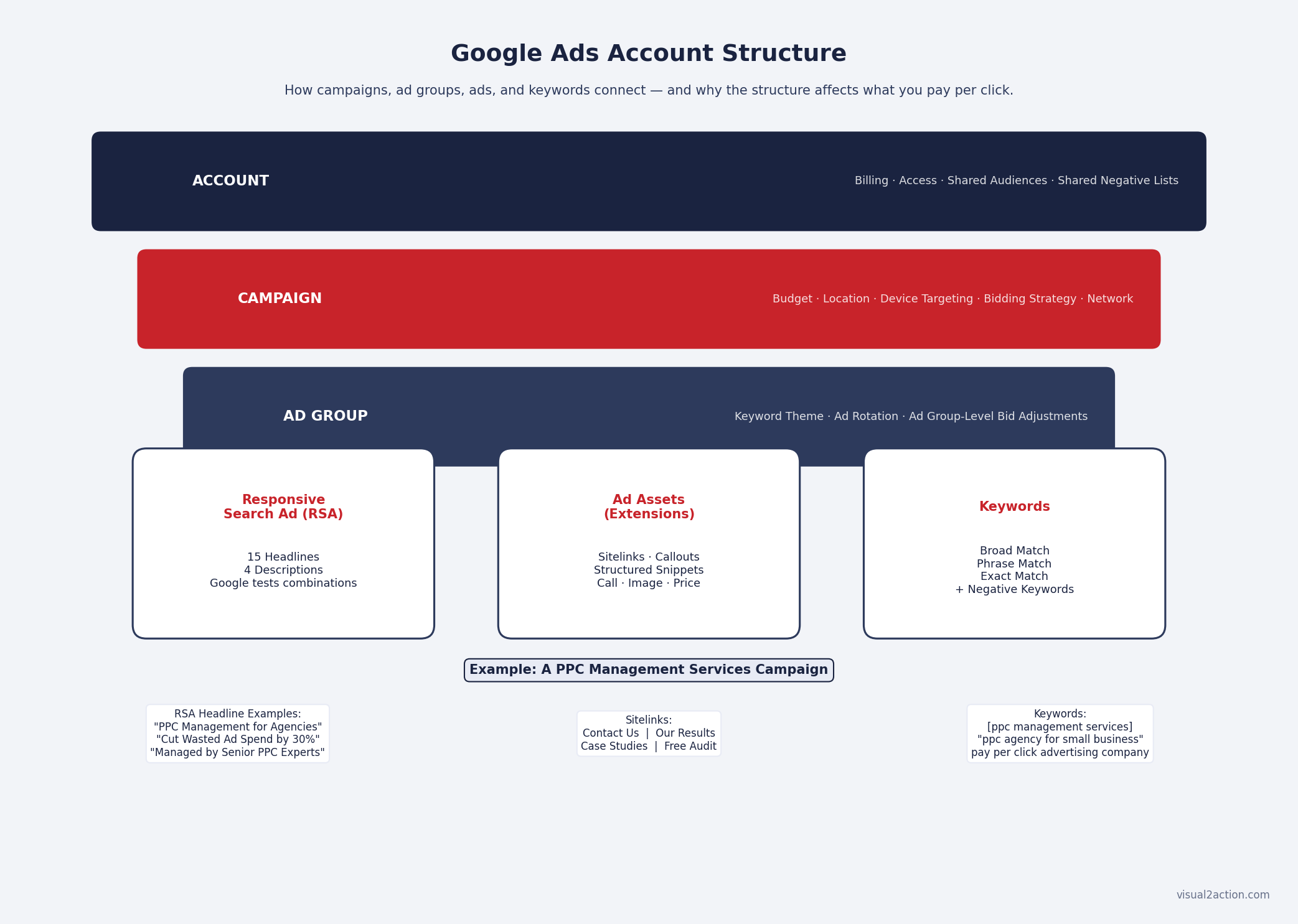
[DIAGRAM 2: PPC Campaign Structure]
Writing Ad Copy That Gets Clicks (Without Sounding Like Every Other Ad)
Responsive Search Ads let you provide up to 15 headlines and 4 descriptions. Google tests combinations and learns which perform best. That sounds like it removes the creative burden. It does not.
The input you give determines the ceiling. Weak headlines limit the best combinations Google can assemble.
What makes a headline work:
- Match the user’s search query in the headline (message match)
- Lead with the specific benefit, not the category
- Include a number where it adds precision (“Cut CPC by 30%” outperforms “Lower Your CPC”)
- Put a clear call to action in at least two headlines
What kills CTR:
- Generic brand-first headlines (“Welcome to [Company Name]”)
- Keyword stuffing without readable meaning
- Ignoring ad extensions (now called “assets”) — sitelinks, callouts, structured snippets, and call assets add visible real estate and lift CTR without extra spend
Ad extensions worth using:
- Sitelink assets: Link to specific pages (contact page, pricing, key service)
- Callout assets: Short phrases highlighting differentiators (“No Setup Fees,” “US-Based Team”)
- Structured snippet assets: Lists of services, products, or features
- Call assets: Phone number shown directly in the ad
- Image assets: Now available on Search campaigns for eligible accounts
The contact page at visual2action.com/contact/ is a common sitelink destination for agencies running lead generation campaigns. A direct link removes friction.
Bidding Strategies: Choosing the Right One for Your Stage
Bidding strategy selection is one of the highest-impact decisions in an account. The wrong strategy at the wrong stage costs real money.
The practical guide:
|
Stage |
Strategy |
Why |
|
Early (limited conversion data) |
Maximize Clicks or Manual CPC |
Collect data without paying for optimization on thin signals |
|
Growing (50+ conversions/month) |
Maximize Conversions or Target CPA |
Enough data for Smart Bidding to find patterns |
|
Mature (stable ROAS history) |
Target ROAS |
Optimizing for revenue return, not just conversion volume |
|
Brand visibility |
Target Impression Share |
Control how often you appear at the top |
Important: Smart Bidding needs conversion data to work. If you switch to Target CPA before you have at least 30 to 50 conversions in a 30-day window, the algorithm is guessing. Manual CPC or Maximize Clicks is the right starting point until you have the data.
First-party data in 2026: With third-party cookies declining and privacy regulations tightening under CCPA 2.0 and the EU AI Act, audience signals based on your own customer data have become critical. Customer Match lists (now accessible with as few as 100 approved users as of Google’s 2025 update), CRM uploads, and on-site conversion signals from GA4 all feed your bidding models with better data than behavioral targeting alone.
Landing Pages: Where PPC Campaigns Win or Lose
Clicks that do not convert are the most expensive line in your PPC budget. A landing page that does not match the ad’s promise is the most common reason campaigns fail.
What a high-converting PPC landing page needs:
- Headline match: The landing page headline should echo the ad headline. If the ad says “Get a Free PPC Audit,” the page headline should not say “Welcome to Our Agency.”
- Above-the-fold clarity: State who the page is for, what you are offering, and what the next step is. Within three seconds of landing, the visitor should know all three.
- Trust signals: Client logos, case study numbers, certifications, or testimonials specific to the offer
- Short forms: Three to five fields maximum for lead generation. Every additional field reduces conversion rate.
- Mobile optimization: Most PPC traffic now converts on mobile. A page that loads slowly or renders poorly on mobile is a direct drain on ROAS.
- Page speed: Google’s Quality Score includes landing page experience. A slow page lowers your score and raises your CPC.
If you are running paid campaigns without a dedicated landing page for each ad group theme, you are leaving conversion rate on the table. Sending all traffic to the homepage is one of the most common and costly PPC mistakes in mid-sized accounts.
For brands running paid campaigns alongside SEO and GEO efforts, there is an additional consideration in 2026: your paid landing pages can also influence how LLMs and AI Overviews reference your brand. Structured, specific, and well-cited landing pages serve both objectives. If you want to understand how GEO and traditional SEO interact with paid performance, the guide on SEO and GEO services for agencies covers the architecture in detail.
Measuring and Optimizing PPC Campaigns: The Metrics That Matter
Clicks and impressions are not performance. They are activity. Performance is what happens after the click.
The metrics worth tracking:
|
Metric |
What It Tells You |
|
CTR (Click-Through Rate) |
Ad relevance and message match quality |
|
Conversion Rate |
Landing page effectiveness and offer alignment |
|
CPC (Cost Per Click) |
Auction competitiveness and Quality Score efficiency |
|
CPA (Cost Per Acquisition) |
Cost efficiency of lead or sale generation |
|
ROAS (Return on Ad Spend) |
Revenue generated per dollar of ad spend |
|
Impression Share |
How often your ads appear vs. how often they are eligible |
|
Quality Score |
Diagnostic of ad relevance, CTR, and landing page experience |
The optimization loop:
Track → Identify gaps → Test one change → Measure → Repeat.
This is not complex. What makes it hard is discipline. Most accounts improve when reviewed weekly, not monthly. Weekly reviews catch budget waste, keyword drift, and auction shifts before they compound.
What to review weekly:
- Search terms report — are irrelevant queries eating budget?
- Auction Insights — are new competitors entering your space?
- Conversion data by keyword — which terms actually produce leads or sales?
- Landing page speed — has anything changed that would affect load time?
What to review monthly:
- Bidding strategy performance — is Smart Bidding improving over time?
- Ad creative performance — which headline combinations are winning?
- Negative keyword additions — what new irrelevant terms appeared?
- Budget allocation — is spend flowing to the highest-performing campaigns?
For paid campaign management that integrates with broader agency delivery, the PPC management services page covers how this structured review process runs inside an active retainer.
AI and Automation in PPC: What to Hand Over and What to Keep
In 2026, automation is not optional. It is built into every major platform by default. The question is not whether to use AI-powered features but which decisions to keep under human control.
What AI handles well:
- Bid adjustments in real time across thousands of auctions
- Creative combination testing across RSA headlines and descriptions
- Audience signal processing and lookalike expansion
- Performance Max campaign placement decisions
What still needs human judgment:
- Conversion goal setup (if the goal is wrong, Smart Bidding optimizes toward the wrong outcome)
- Negative keyword strategy (automation does not exclude without instruction)
- Campaign structure and theme separation
- Landing page copy and offer positioning
- Budget allocation decisions across campaigns
Google’s Performance Max campaigns and Meta’s Advantage+ are designed to take over more of the management surface. They can produce strong results when fed clean conversion data, clear audience exclusions, and strong creative. Without those inputs, they tend to spend efficiently toward low-value outcomes.
The practical guidance for 2026: treat AI as a bidding and placement optimizer. Keep creative strategy, offer development, and audience segmentation logic in human hands.
Common PPC Mistakes and How to Avoid Them
These are the patterns that consistently reduce performance across accounts, regardless of budget size.
- Ignoring negative keywords from the start Negative keywords should be built before the campaign launches, not after two weeks of waste. Pull your search terms report from any previous campaigns or competitor analysis tools and build the exclusion list before go-live.
- Sending all traffic to the homepage The homepage is designed for a visitor who does not know what they want yet. A PPC visitor clicked a specific ad. Send them to a page built for that specific offer.
- Switching bidding strategies too fast Smart Bidding needs a learning period of at least two to four weeks. Changing the strategy every few days resets the learning and prevents the algorithm from stabilizing.
- Not tracking conversions properly If Google Ads does not have conversion tracking set up, you are optimizing for clicks. Make sure GA4 is linked, conversion actions are firing correctly, and enhanced conversions are enabled where possible.
- Ignoring mobile performance More than half of PPC traffic converts on mobile. If your landing page is not mobile-optimized, your CPA is being inflated by every visitor who bounces on a phone.
- Skipping A/B testing Running one ad per ad group and letting it run indefinitely produces no learning. Rotate two to three ad variants, let performance data accumulate, then pause the weaker ones.
- Setting it and forgetting it PPC is not a passive channel. Auction dynamics shift. Competitor bids change. Seasonal demand moves. An account that is not reviewed weekly starts losing ground in the second month.
Frequently Asked Questions About PPC Advertising
What is the difference between PPC and SEO?
PPC produces traffic immediately once a campaign is live, and you pay for each click. SEO produces organic traffic over months of content and technical work, but you do not pay per click. Most businesses benefit from running both in parallel: PPC captures immediate high-intent traffic while SEO builds durable organic visibility. For a view of how SEO and GEO strategies now interact, see the GEO and SEO services guide.
How much does PPC advertising cost?
There is no fixed cost. You set your daily budget and your maximum bid per click. Google will spend up to your daily budget and will not exceed your bid cap. The actual cost per click varies by industry, keyword competition, and Quality Score. Highly competitive industries like legal, finance, and insurance typically see CPCs of $10 to $50 or more. Niche B2B terms often cost $3 to $15 per click. You can start testing with as little as $500 per month to collect meaningful data.
What is a good ROAS for PPC campaigns?
ROAS (return on ad spend) depends entirely on your margins and business model. An e-commerce brand with 40% gross margins typically needs a ROAS of at least 3x to break even on ad spend before fixed costs. A SaaS company with high LTV and low COGS might accept a 1.5x ROAS in an acquisition phase. There is no universal benchmark. Establish your breakeven ROAS first, then use that as the floor for your Target ROAS bidding strategy.
How long does it take for PPC campaigns to produce results?
You can see traffic on day one. Meaningful performance data takes four to six weeks to accumulate. Smart Bidding strategies typically stabilize within two to four weeks. Plan for a 60-day window before drawing conclusions about whether a campaign structure is working.
What is Performance Max and should I use it?
Performance Max (PMax) is a campaign type where Google manages placements, creative, and bidding across all of its properties. It works best for accounts with strong conversion history, good creative assets, and clear audience signals. For newer accounts without conversion data, start with Search campaigns. Once you have 50 or more monthly conversions, PMax becomes a more viable channel expansion.
Should PPC campaigns be managed in-house or by an agency?
This depends on internal capacity and the complexity of the account. Accounts spending under $5,000 per month with one or two campaigns can often be managed well in-house with proper training. Accounts above $10,000 per month with multiple campaigns, campaign types, and conversion goals benefit from dedicated management where the optimization work is not competing with other business priorities. The PPC management services page outlines what ongoing paid campaign management covers in a structured retainer.
What is a Quality Score and how do I improve it?
Quality Score is a 1 to 10 diagnostic rating Google assigns at the keyword level. It reflects expected CTR, ad relevance, and landing page experience. A higher score means lower CPC and better ad positions. To improve it: tighten your ad group themes so each keyword is served by highly relevant ad copy, match your landing page content closely to the ad promise, and remove or restructure keywords with consistently low CTR.
If your paid campaigns are delivering traffic but not leads, or if you are scaling spend without proportional ROAS growth, the issue is usually structural rather than budgetary. The PPC management services page covers how Visual2Action runs paid media management as an integrated part of a performance fulfillment engagement. Or, if you are ready to talk through your account, contact the team.

Jilesh Varma, Co-Founder of Visual2Action, scales Shopify brands using 12+ years of data-driven performance marketing. Specializing in paid media and full-funnel demand generation, he leverages analytical insights to turn ad spend into measurable, ROI-driven growth.