

ChatGPT Prompts for SEO: The Complete Practical Guide
Most guides on ChatGPT prompts for SEO hand you a numbered list and call it done. The problem is that a prompt without context about why it works, what output to expect, and how to iterate when it falls short is just a sentence. You still have to do the thinking.
This guide is structured differently. Every prompt here comes with the reasoning behind it, the variables you should change for your specific use case, and the follow-up prompts that sharpen the output. We also cover prompt engineering principles that apply across every SEO task so you build a reusable system, not a list you forget after one use.
At Visual2Action, we use ChatGPT across keyword research, content production, technical SEO workflows, and schema generation. What is in this guide comes from active use, not theory.
By the end, you will have a working prompt library organized by task, an understanding of how to write better prompts on your own, and a clear picture of where ChatGPT genuinely accelerates SEO work and where it still needs human judgment behind it.
What Makes a ChatGPT Prompt Work for SEO
Before the prompt library, you need to understand the variables that determine whether ChatGPT produces something useful or something generic.
ChatGPT responds to the full context of what you give it. A vague prompt produces a vague answer. A prompt with a defined role, a specific task, a clear format requirement, and relevant context produces something close to what a good SEO analyst would write.
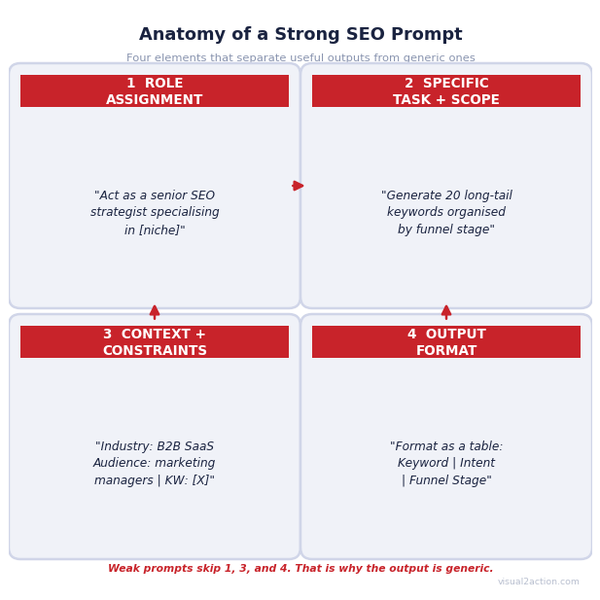
The four elements every strong SEO prompt needs:
1. Role assignment Tell ChatGPT what it is before you tell it what to do. “Act as a senior SEO strategist with experience in technical audits for e-commerce sites” produces a different response than no role at all. The role frames the vocabulary, the level of detail, and the assumptions ChatGPT makes.
2. Specific task with defined scope Vague tasks produce vague outputs. “Write a meta description” is weak. “Write three meta description variations for a product page targeting the keyword ‘noise-cancelling headphones for travel’, each under 155 characters, each with a different emotional angle” is strong. The constraint is the craft.
3. Context and constraints Industry, audience, word count, format, tone, keyword, and competing pages are all context. The more relevant context you include, the less ChatGPT has to guess about what you need.
4. Output format instruction Tell ChatGPT exactly how to structure the output. Tables, numbered lists, JSON-LD blocks, bullet points, prose paragraphs. Without this instruction, ChatGPT picks a format that may not fit your workflow.
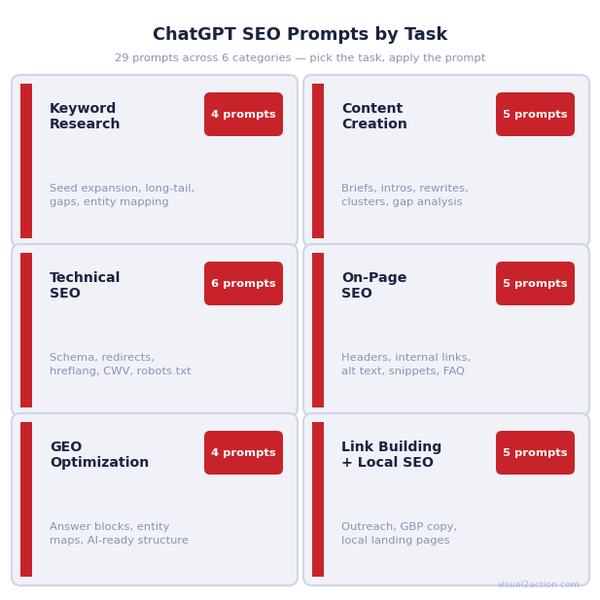
ChatGPT Prompts for Keyword Research
Keyword research is one of the highest-value applications of ChatGPT in SEO. It does not replace tools like SEMrush, Ahrefs, or Google Keyword Planner. What it does is expand your thinking faster than manual brainstorming and surface angles you would likely miss.
Prompt 1: Seed keyword expansion
Act as a senior SEO keyword strategist. I am targeting the topic
"[your topic]" for a [describe your business and target audience].
Generate 30 keyword variations organized into three groups:
(1) high-intent commercial keywords, (2) informational long-tail
keywords, and (3) question-based keywords a buyer would search
before making a purchase decision. For each keyword, note the
likely search intent (informational, navigational, commercial,
or transactional).
Prompt 2: Long-tail keyword discovery from a seed term
Act as an SEO specialist. Given the seed keyword "[seed keyword]",
generate 20 long-tail keyword variations that a buyer would search
at different stages of the purchase journey. Organize by funnel
stage: top of funnel (awareness), middle of funnel (consideration),
bottom of funnel (decision). Format as a table with columns:
Keyword | Funnel Stage | Search Intent | Example Content Type.
Prompt 3: Competitor keyword gap analysia
Act as an SEO analyst. My website covers [your main topic].
My top three competitors are [competitor 1], [competitor 2],
[competitor 3]. Based on what you know about these sites,
identify 15 keyword topics they likely rank for that I have
not yet covered. Focus on topics with clear informational
or commercial intent that would logically fit my content strategy.
Prompt 4: People Also Ask and semantic keyword expansion
Act as an SEO content strategist. For the primary keyword
"[keyword]", generate: (1) 10 semantically related terms that
should appear naturally in the body copy of a page targeting
this keyword, (2) 8 questions a user would ask before, during,
and after searching this term, (3) 5 related entities (people,
brands, tools, concepts) that Google associates with this topic.
ChatGPT Prompts for Content Creation and Optimization
Content creation is where most people start using ChatGPT for SEO. It is also where the quality gap between good prompts and weak prompts is most visible.
Prompt 5: Full article brief generation
Act as a senior SEO content strategist. Create a detailed content
brief for an article targeting the primary keyword "[keyword]"
for a [describe business and audience]. The brief should include:
(1) recommended H1, (2) meta title under 60 characters,
(3) meta description under 155 characters, (4) content outline
with H2 and H3 headings, (5) semantic keywords to include
naturally, (6) questions to answer in the FAQ section,
(7) suggested internal links, (8) recommended word count range,
(9) content angle that differentiates from the top 3 ranking
pages.
Prompt 6: Introduction paragraph that avoids AI-sounding language
Act as an experienced SEO content writer. Write the opening
paragraph for an article about "[topic]". The target keyword
is "[keyword]". Write in active voice. Do not use the words
'ensure', 'leverage', 'game-changer', or 'delve'. Do not use
em dashes. The tone should be direct and informative, written
for [describe audience]. The opening should establish the
reader's problem in the first sentence and signal what the
article resolves. Maximum 100 words.
Prompt 7: Content gap analysis against a specific URL
Act as an SEO analyst. I want to outrank the following page
for the keyword "[keyword]": [paste URL or describe competitor
content]. Analyze what that page covers and identify:
(1) topics it addresses well that I must also cover,
(2) topics it misses or covers superficially that I can go
deeper on, (3) questions a reader would still have after
reading that page, (4) a recommended angle for my page that
differentiates it. Format as a structured report.
Prompt 8: Rewriting existing content for clarity and SEO
Act as an SEO editor. Rewrite the following paragraph to
improve clarity and keyword relevance for the target keyword
"[keyword]". Requirements: active voice only, no em dashes,
no passive constructions, no filler phrases like 'it is
important to note', maximum [word count] words, retain all
factual information from the original. Here is the original:
[paste paragraph]
Prompt 9: Topical authority content cluster planning
Act as a senior SEO strategist. I want to build topical
authority around "[main topic]" for a [describe business].
Design a content cluster with: (1) one pillar page topic
with recommended H1, (2) 8 cluster article topics that
support the pillar, each with a recommended H1 and primary
keyword, (3) internal linking logic showing which cluster
articles link to each other and back to the pillar,
(4) the search intent for each cluster article.
Format as a structured map.
Topical clusters are now more important than ever because both traditional Google ranking and AI citation preference favor sites with demonstrated depth on a topic. A single well-written page is weaker than a well-connected cluster of pages that collectively answer every question in a subject area. For how this connects to the broader SEO and GEO strategy, the GEO and SEO services guide covers the architecture in detail.
ChatGPT Prompts for Technical SEO
This is the area most ChatGPT SEO prompt guides skip entirely. Technical SEO tasks are time-consuming, repetitive, and precisely the kind of work that ChatGPT accelerates without replacing professional judgment.
Prompt 10: Meta title and description generation at scale
Act as an SEO copywriter. Generate optimized meta titles and
meta descriptions for the following 10 pages. For each page,
write: (1) meta title under 60 characters that includes the
primary keyword, (2) meta description under 155 characters
that includes the keyword and a clear call to action.
Pages: [list page names, URLs, and primary keywords]
Prompt 11: Schema markup generation
Act as a technical SEO specialist. Generate valid JSON-LD
schema markup for the following [schema type: Article /
FAQPage / Product / LocalBusiness / HowTo].
Here are the details: [paste relevant page details].
Output only the raw JSON-LD block. Do not include
explanatory text. Validate the structure against
schema.org specifications.
Prompt 12: Robots.txt audit and recommendations
Act as a technical SEO analyst. Review the following
robots.txt file and identify: (1) any directives that
may be blocking important pages from crawling,
(2) missing directives that should be added,
(3) any syntax errors. Provide specific recommended
changes with explanations. Here is the file: [paste content]
Prompt 13: Redirect mapping for site migration
Act as a technical SEO specialist managing a site migration.
I am moving from [old URL structure] to [new URL structure].
Create a redirect mapping plan for the following old URLs.
For each, recommend the correct 301 redirect destination
based on content relevance. Flag any URLs where the redirect
destination is unclear and explain why.
URLs: [paste list]
Prompt 14: Hreflang tag generation for international pages
Act as an international SEO specialist. Generate the correct
hreflang tag set for a page that exists in the following
language and region variations: [list languages and URLs].
Output as ready-to-paste HTML link tags. Follow Google's
hreflang specification exactly.
Prompt 15: Core Web Vitals interpretation
Act as a technical SEO specialist. I have run a Core Web
Vitals audit on my page [URL or describe page type].
The results are: LCP = [value], INP = [value], CLS = [value].
Explain what each metric means in plain language, whether
these scores are within Google's recommended thresholds,
and give me three specific actions to improve each metric
that is outside the threshold.ChatGPT Prompts for On-Page SEO
On-page optimization is where ChatGPT earns its time savings most consistently. These tasks are precise, repetitive, and rule-based, which is exactly what ChatGPT handles well with a well-structured prompt.
Prompt 16: Header structure audit and recommendations
Act as an on-page SEO specialist. Review the following
page content and: (1) identify any H1, H2, H3 hierarchy
issues, (2) recommend revised headings that better target
the primary keyword "[keyword]" and related semantic terms,
(3) flag any headings that are keyword-stuffed or
irrelevant to the page intent. Here is the current content:
[paste content]
Prompt 17: Internal linking recommendations
Act as an SEO strategist. I have a page about "[topic A]"
at [URL]. I want to identify the best internal linking
opportunities from this page to other pages on my site
and from other pages back to this one.
My other pages cover: [list topics/URLs].
Recommend: (1) anchor text and destination for 3 outgoing
internal links from this page, (2) 3 pages that should
link back to this page with recommended anchor text,
(3) whether any of these should be a primary contextual
link or a sidebar/footer link.
Prompt 18: Image alt text generation
Act as an SEO specialist. Write descriptive, keyword-relevant
alt text for the following images on a page targeting
the keyword "[keyword]". Alt text should be descriptive
of what the image shows, relevant to the page topic,
and under 125 characters each. Images: [describe each image]
Prompt 19: Featured snippet optimization
Act as an SEO content specialist. I want to optimize the
following section of my page to win the featured snippet
for the query "[target query]". Rewrite it so that:
(1) the answer appears within the first 40 to 50 words,
(2) it directly addresses the query without preamble,
(3) if a list or table would make the answer clearer,
use that format. Here is the current content: [paste section]
Prompt 20: FAQ section generation for SEO and schema
Act as an SEO content writer. Generate a FAQ section
for a page targeting "[primary keyword]" for [audience].
Write 7 questions and answers. Requirements:
(1) questions should match how real users phrase searches,
including question-based searches,
(2) answers should be 40 to 80 words each,
(3) answers should be direct with no preamble,
(4) include semantic keywords naturally in the answers,
(5) format each Q and A so it can be directly used in
FAQPage JSON-LD schema.
ChatGPT Prompts for GEO: Getting Cited in AI-Generated Answers
This is the section none of the competing guides cover. If you want your content cited in Google AI Overviews, ChatGPT Search, Perplexity, or Gemini, you need to optimize differently than you do for traditional blue-link rankings.
GEO, or Generative Engine Optimization, requires content that AI systems can parse, trust, and extract a clear answer from. ChatGPT can help you write and structure content to meet those requirements.
Prompt 21: GEO-optimized answer block creation
Act as a GEO specialist. Write a direct-answer block for
the question "[target question]". Requirements:
(1) answer the question completely in the first 60 words,
(2) use clear declarative sentences with no hedging,
(3) include the most relevant entities (people, brands,
tools, concepts) associated with this topic,
(4) cite a specific fact or statistic if one is relevant,
(5) follow with a 2-sentence supporting explanation.
This block will sit near the top of a page and is
optimized for AI Overview citation.
Prompt 22: Topical authority entity mapping
Act as a GEO and SEO strategist. For the topic "[main topic]",
identify: (1) the primary entities Google and AI systems
associate with this topic, including people, brands, tools,
concepts, and organizations, (2) which of these entities
my content should mention to establish topical credibility,
(3) semantic relationships between these entities that
should be expressed in my content, (4) the questions
AI systems are most likely to surface answers for
on this topic. Format as a structured entity map.
Prompt 23: Content structured for AI extraction
Act as a GEO content specialist. Rewrite the following
section of content so it is structured for AI system
extraction. Requirements: (1) use H2 and H3 headings
that match the exact question a user would ask,
(2) place the direct answer within the first sentence
under each heading, (3) use short paragraphs of 2 to 3
sentences maximum, (4) add a definitions list where
technical terms are used, (5) flag where a table or
numbered list would make the information clearer
for AI parsing. Here is the current content: [paste]
Prompt 24: Schema markup for GEO visibility
Act as a technical SEO and GEO specialist. Generate
a complete JSON-LD schema block for a page about
"[topic]" that maximizes AI system trust signals.
Include: Article schema with headline, author (name,
url, sameAs), publisher, dateModified, and keywords.
Add a FAQPage block with [number] questions and answers.
Use @graph to combine both in one script tag.
Output only the raw JSON-LD. No explanatory text.
If you want to understand how GEO and SEO work together in a campaign structure rather than just at the page level, the digital marketing trends guide covers the broader shift in how search and AI discovery now interact.
ChatGPT Prompts for Link Building and Digital PR
Prompt 25: Link prospect identification
Act as a link building specialist. I have a piece of
content about "[topic]" at [URL or describe content].
Identify 10 types of websites, publications, or content
creators who would have a genuine reason to link to
this content. For each, explain the relevance and
suggest a specific outreach angle. Avoid generic
suggestions like 'blogs in your niche.'
Prompt 26: Outreach email that does not sound like a template
Act as a digital PR specialist. Write an outreach email
to [describe recipient, e.g., editor of a marketing
publication] about linking to my content on "[topic]"
at [URL]. Requirements: (1) subject line under 8 words,
(2) opening sentence references something specific about
their publication or recent content, (3) value proposition
is clear in one sentence, (4) no use of phrases like
'I hope this email finds you well' or 'I wanted to reach
out', (5) under 120 words total, (6) active voice only.
Prompt 27: Broken link building prospecting
Act as a link building specialist. I want to identify
broken link opportunities in the content space around
"[topic]". Describe: (1) the types of pages in this
niche most likely to have outdated or broken external
links, (2) the search operators I should use in Google
to find these pages, (3) the outreach approach that
works best for broken link replacement requests,
(4) a short email template for the broken link
replacement pitch.
ChatGPT Prompts for Local SEO
Prompt 28: Google Business Profile description optimization
Act as a local SEO specialist. Write an optimized
Google Business Profile description for [business name],
a [business type] located in [city]. Primary services:
[list services]. Target keywords: [list 3 to 5 keywords].
Requirements: under 750 characters, include the city
and primary service in the first sentence, active voice,
no keyword stuffing, include one clear call to action.
Prompt 29: Local landing page content
Act as a local SEO content writer. Write the body
content for a local landing page targeting the
keyword "[service] in [city]". The business is [describe].
Requirements: (1) H1 that includes keyword, (2) opening
paragraph that mentions the city and service in the
first sentence, (3) section on why local customers
choose this business over national alternatives,
(4) FAQ section with 4 questions a local buyer would ask,
(5) closing paragraph with a clear call to action,
(6) total word count 600 to 800 words.
Iterative Prompting: How to Improve Any Output
The first response is rarely the final output. The difference between marketers who get consistent value from ChatGPT and those who abandon it after a few tries is iterative prompting.
How to iterate effectively:
After receiving an initial output, use one of these follow-up prompts to sharpen it:
To improve specificity:
That is too generic. Rewrite with specific examples
relevant to [your industry/audience]. Replace any
vague claims with concrete details.
To fix tone:
Rewrite in a more direct, less corporate tone.
Remove any phrases that sound like marketing copy.
Write as if explaining to a knowledgeable peer.
To tighten length:
Reduce by 30%. Keep every factual claim.
Remove filler sentences. Prioritize the most
actionable information.
To add depth to a specific section:
Expand the section on [specific topic] with two
additional paragraphs that go deeper on [specific angle].
Add one concrete example.
To check for SEO alignment:
Review the content you just wrote. Identify:
(1) where the primary keyword "[keyword]" appears
and whether placement feels natural, (2) which semantic
terms are missing that should appear for this topic,
(3) any heading that could be rewritten to better
match a search query.
Where ChatGPT Helps and Where It Does Not
Understanding the limits is as important as knowing the prompts.
ChatGPT handles these SEO tasks well:
- First drafts of content at any length
- Meta title and description variations
- Schema markup generation
- Keyword brainstorming and semantic expansion
- Content brief creation
- FAQ generation
- Outreach email drafts
- Content restructuring for clarity
- Header hierarchy review
- Local page content templates
ChatGPT requires human verification for:
- Keyword volume and competition data (it does not have real-time search data)
- Backlink profiles and domain authority metrics
- Actual ranking positions
- Site crawl errors and technical audit findings
- Current algorithm update details after its knowledge cutoff
- Factual claims that need source verification
ChatGPT is not a replacement for:
- Strategic decisions about which topics to target
- Creative positioning and brand differentiation
- Relationship-based link building outreach
- Interpreting why rankings changed
- Building trust with an audience over time
For teams managing paid campaigns alongside SEO, the PPC management services page covers how paid and organic work together in a full-funnel engagement. If you want to talk through how ChatGPT fits into a broader content and SEO strategy for your business, the team is available through the contact page.
Frequently Asked Questions
What is the best ChatGPT prompt for SEO content writing?
The most effective prompt for SEO content writing assigns ChatGPT a specific role (senior SEO content writer), gives it the primary keyword and target audience, specifies the exact format and word count, lists banned phrases and style rules, and includes context about the competing content it needs to outperform. A prompt with all five of these elements consistently produces more usable output than a prompt that only states the topic.
Can ChatGPT do keyword research for SEO?
ChatGPT cannot pull real search volume or competition data. What it does well is expand your keyword thinking: generating long-tail variations, surfacing question-based queries, organizing keywords by funnel stage and search intent, and identifying semantic terms and entities that should appear alongside your primary keyword. Use it alongside Ahrefs, SEMrush, or Google Keyword Planner for a complete picture.
How do I use ChatGPT for technical SEO?
ChatGPT handles several technical SEO tasks effectively: generating JSON-LD schema markup, creating redirect mapping plans, reviewing robots.txt files for errors, writing hreflang tags, interpreting Core Web Vitals results, and generating canonical tag recommendations. Paste the relevant technical data or code directly into your prompt and give ChatGPT a specific technical role to work from.
What is prompt engineering for SEO?
Prompt engineering for SEO is the practice of structuring your ChatGPT instructions to produce consistently high-quality, task-specific outputs. It involves assigning a role, specifying the task with clear constraints, providing relevant context, and defining the output format. The goal is to move from one-off prompts to a reusable system that produces predictable, professional-level outputs for keyword research, content creation, technical tasks, and schema generation.
How do I use ChatGPT for GEO (Generative Engine Optimization)?
For GEO, use ChatGPT to write direct-answer blocks that AI systems can extract and cite, map entities and semantic relationships for a topic, restructure existing content so it places the answer before the explanation, and generate FAQPage and Article schema markup that signals trust to AI crawlers. The goal is content that a machine can parse into a clear, citable answer, not just content that reads well for a human.
Are ChatGPT-generated SEO prompts free to use?
The prompts themselves, meaning the frameworks and structures for instructing ChatGPT, are not proprietary. What matters is how well you customize them for your specific keywords, audience, industry, and content goals. A prompt copied without customization produces the same generic output everyone else gets. The value is in the variables you fill in and the iterative process you use to refine the output.
How many prompts should I use per piece of content?
Professional SEO content workflows typically use four to eight prompts per article: one for the brief, one for the outline, one or two for the draft sections, one for the meta data, one for the FAQ section, and one or two iterative refinement prompts. Treating each prompt as a standalone instruction rather than part of a conversation is the most common reason outputs feel disconnected from each other.
If you are building a content and SEO strategy and want to understand how ChatGPT fits into a broader organic growth system rather than just individual page optimization, Visual2Action works with agencies and businesses on integrated digital marketing engagements. The about page explains how the team is structured, and the contact page is the fastest way to start a conversation.

Deep Gopalani is an SEO Analyst at Visual2Action, merging technical SEO with conversion-driven copywriting. He manages end-to-end organic growth, from technical audits and code tweaks to GMB, backlinks, and pillar-cluster strategies that drive measurable results.